UK Top Ranked Best UFC Betting Websites
 Available in US
I placed my first UFC bet in 2017 on a prelim fighter nobody was talking about, and the sportsbook I used that night no longer exists. That single experience taught me something that nine years of analysing fight odds have only reinforced: the platform you bet on matters almost as much as the pick itself. A slow interface, thin market coverage, or a dodgy regulatory status can quietly eat into your edge long before a bad read on a southpaw ever does.
The MMA betting handle hit $10.3 billion in 2024, climbing 17% year on year, and the UK sits at the centre of some of the most aggressive regulatory shifts the industry has seen in a decade. Remote Gaming Duty jumped to 40% in April 2026, the Gambling Commission is issuing cease-and-desist notices at record pace, and UFC itself signed a $7.7 billion media deal with Paramount+ that killed the traditional pay-per-view model overnight. Every one of those changes ripples through the sportsbooks available to UK punters — from the odds on offer to the markets you can access to the speed of your cash-out button during a live fight.
This guide is built around data, not affiliate deals. I have spent months pulling financial filings, regulatory reports, and platform performance metrics to rank the UFC betting websites that actually serve UK bettors well in 2026. You will find market analysis, regulatory context, strategy primers, and honest assessments of what each type of platform does right and wrong. Whether you are placing your first moneyline wager or refining a method-of-victory approach across a full fight card, this is the resource I wish I had had when I started.
Table of Contents
- Data-Backed Ranking Criteria for UK UFC Bookmakers
- How Big Is the UFC Betting Market in 2026
- Top UFC Betting Websites for UK Punters
- UFC Betting Markets Explained: From Moneyline to Prop Bets
- In-Play Betting on UFC: What UK Sites Offer
- The Paramount+ Era: How UFC’s Media Deal Changes Betting
- UK Gambling Regulation and What It Means for UFC Bettors
- Betting Integrity: How UFC Fights Are Monitored
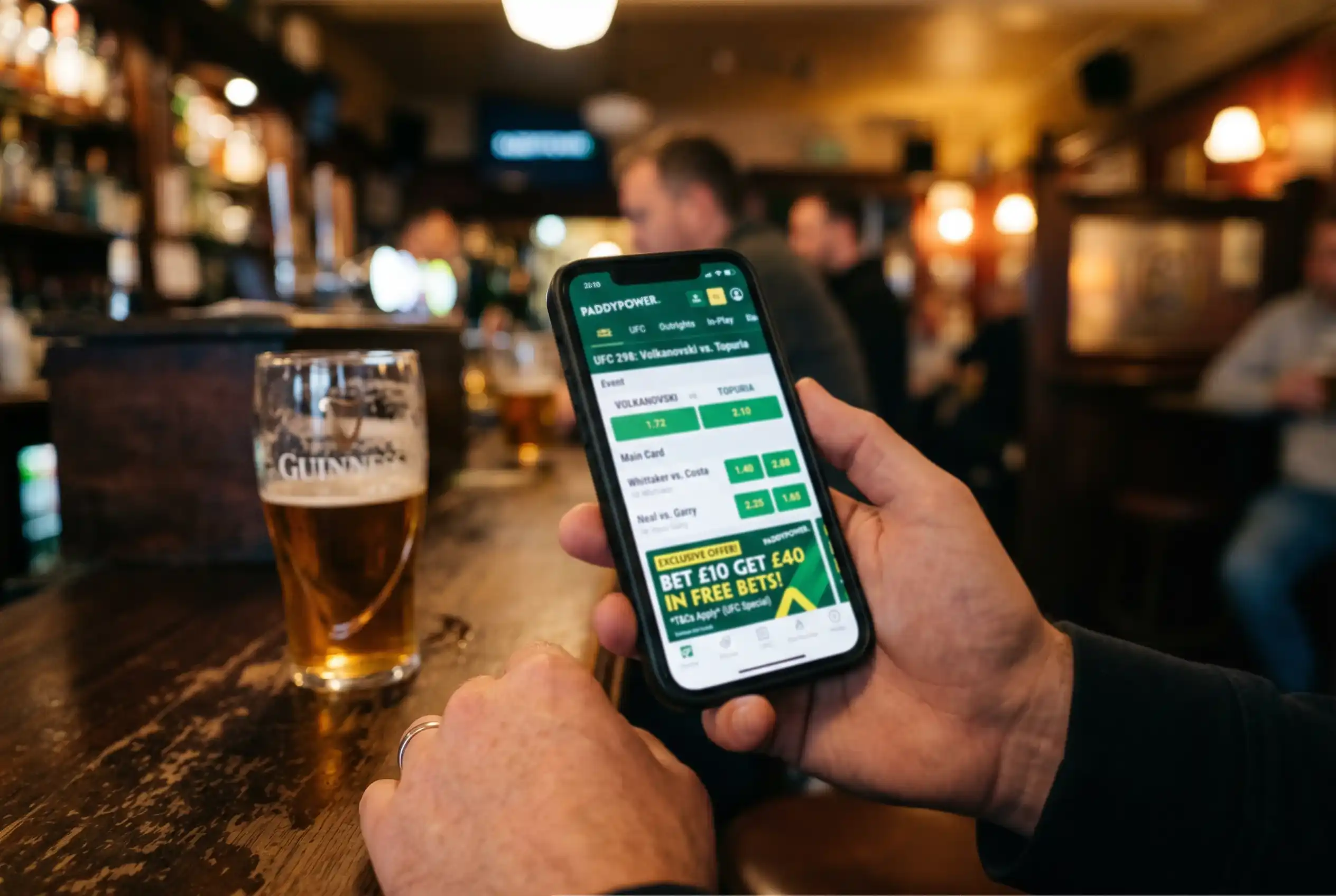
- UFC Betting Apps: Mobile Experience in the UK
- UFC Betting Strategy: A Data-Driven Starting Point
- Frequently Asked Questions
Data-Backed Ranking Criteria for UK UFC Bookmakers
- The MMA betting handle reached $10.3 billion in 2024 (up 17%), and UFC alone generated $1.5 billion in revenue with a 57% EBITDA margin — the sport’s commercial weight now directly shapes market depth and odds quality at UK sportsbooks.
- Remote Gaming Duty doubled to 40% in April 2026, squeezing operator margins. Expect the effects in tighter odds and fewer promotions across the board.
- The $7.7 billion Paramount+ deal eliminated pay-per-view, putting every UFC event behind a single subscription and expanding the betting audience by making 42-43 annual events fully accessible.
- In-play betting captures 62.35% of global online wagering revenue, and mobile devices process 80% of all bets. If your sportsbook’s app cannot keep live UFC markets open during rounds, you are betting with a structural disadvantage.
- Stick to UKGC-licensed platforms — the Commission blocked 504 unlicensed sites this financial year — and evaluate sportsbooks on UFC-specific criteria: market depth, live speed, and bet builder functionality.
How Big Is the UFC Betting Market in 2026
A friend of mine who works in sports media once told me that UFC would never rival football for betting volume in the UK. I pulled up the numbers over a pint and watched his expression change. The global UFC market is valued at $1.74 billion in 2026, projected to reach $2.79 billion by 2033 at a compound annual growth rate of 8%. The broader MMA market grew from roughly $1.2 billion in 2020 to approximately $2.2 billion by 2025. These are not niche figures — this is a sport that has quietly muscled its way into the mainstream of global wagering.
MMA Betting Handle
$10.3 billion in 2024, up 17% year on year
UFC Revenue
$1.502 billion in 2025, 57% EBITDA margin
UK Gambling GGY
£15.6 billion total, £11.5 billion excluding lotteries
Online Betting Share
Sports betting accounts for 52% of all online wagers globally

What makes these figures matter for someone choosing a betting website is the downstream effect. When a sport generates this kind of handle, sportsbooks invest in deeper markets, sharper odds, and faster live-betting infrastructure. UFC generated $1.502 billion in revenue in 2025 with a staggering 57% EBITDA margin — numbers that rival established North American leagues. Media rights alone contributed $907.7 million, sponsorship added $314.3 million (up 28% year on year), and live events brought in $232.9 million. TKO’s executive chair Ariel Emanuel put it plainly when discussing those results: the company is “extremely well positioned with long-term media rights agreements in place and operational strength across the business.”
For UK bettors specifically, the numbers carry a regulatory dimension. The total gross gambling yield for the British industry reached £15.6 billion in the year to March 2024 — the highest the Gambling Commission has ever recorded. Remote casino, betting, and bingo GGY hit £6.9 billion, up 6.9% year on year and more than 20% above pre-pandemic levels. The online segment is not just growing; it is where the gravitational centre of UK gambling now sits. And within that online segment, combat sports betting is one of the fastest-expanding verticals, driven by UFC’s relentless event schedule and a demographic profile that skews younger and more digitally native than traditional football punters.
The global online gambling market exceeded $121 billion in 2025 — and sports betting captured 52% of all online wagers. MMA’s share of that pie has roughly doubled since 2020.
The scale of the market also explains why sportsbook competition is intensifying. The UK’s online gambling sector is a mature, high-revenue environment where operators must differentiate on product quality to win market share. When the sport you are betting on generates a $10 billion annual handle and the league behind it posts a 57% profit margin, operators have every incentive to build out their UFC product — deeper markets, earlier odds, better live coverage. The sportsbooks that recognise MMA as a growth vertical, rather than a side offering tucked behind football and horse racing, are the ones delivering the best experience for combat sports bettors right now.
Top UFC Betting Websites for UK Punters
I have lost count of the “top 10 UFC betting sites” lists I have read that turned out to be thinly veiled affiliate pages with identical copy for every operator. The reality is that ranking sportsbooks for UFC requires a framework that treats combat sports as fundamentally different from football or horse racing. A platform might be brilliant for Premier League accas and utterly mediocre when you need round-by-round props on a Fight Night card at 3 a.m.
Rather than handing you a numbered list of brands with star ratings, I want to walk through what actually separates the platforms that serve UFC bettors well from those that merely list UFC as an afterthought in their sports menu. The UK market in 2026 has a handful of operators with genuinely deep UFC coverage, a larger middle tier that offers the basics competently, and a long tail of sites where MMA markets appear sporadically if they appear at all.
| Feature | Deep UFC Coverage | Basic UFC Coverage |
|---|---|---|
| Market depth per fight | 15+ markets including round betting, method groups, fight props | 3-5 markets, typically moneyline and over/under rounds |
| Prelim coverage | Full card from early prelims through main event | Main card only, sometimes co-main onward |
| Live betting | Round-by-round in-play with method-of-victory shifts | Limited or suspended during rounds |
| Bet builder | UFC-specific same-game multi with correlated selections | Generic multi-sport builder, UFC not always included |
| Odds publication timing | 7-10 days pre-event | 2-3 days pre-event or fight-week only |

The financial health of the operator behind a sportsbook is not something most punters think about, but it should be. Flutter Entertainment posted $15.91 billion in revenue in 2025, growing 17% year on year, with adjusted EBITDA of $2.85 billion. That kind of financial muscle translates directly into product investment — better apps, faster odds engines, and wider market coverage. On the other side of the ledger, Entain recorded a net loss of £681 million, with a £488 million impairment weighing heavily on the books. An operator under financial strain may still function perfectly well for your weekend bets, but it is worth knowing the landscape when you are deciding where to hold your bankroll long-term.
The remote online segment is growing faster than retail across the UK gambling industry. For UFC bettors, this means the sportsbooks competing for your action have more revenue — and more commercial incentive — to invest in niche sports coverage than at any previous point.
What I look for personally is a combination of market depth, odds competitiveness, and operational reliability. A sportsbook that opens UFC lines early, prices method-of-victory markets with tight margins, and does not suspend live betting every time a significant strike lands is doing the fundamentals right. One that layers on a functional bet builder, fast withdrawals, and a mobile app that does not crash on fight night is doing everything right. The platforms that tick those boxes are the ones I keep coming back to, and they are the ones that consistently appear at the top of any honest assessment of the UK market.
Andrew Rhodes, who served as CEO of the Gambling Commission, noted during his ICE 2025 address that UK gambling had reached the highest GGY ever seen. That statement was not a boast — it was a framing device for the regulatory scrutiny that follows record revenue. For UFC bettors, it means the sites that are thriving financially are also the ones under the most intense regulatory oversight, which paradoxically makes them safer places to bet.
How We Evaluate and Rank Each Sportsbook
Every ranking on this site follows a consistent evaluation framework, and I want to be transparent about what goes into it. I do not accept payment from operators, and I do not adjust scores based on affiliate commissions. The criteria below reflect what actually matters when you are betting on UFC fights week after week, not what looks good in a promotional banner.
The remote betting and gaming segment generated £6.9 billion in GGY in the most recent reporting period, a 6.9% increase year on year. That level of competition means operators are fighting for your business — and the ones worth using are the ones that compete on product quality rather than misleading promotional claims.
The platform matters almost as much as the pick. This scorecard uses the same weighting a good UFC-focused review applies: market depth and odds competitiveness carry the most weight, followed by live betting & cash-out, then bet builder, app stability and withdrawals. A UKGC licence is non-negotiable — an unlicensed site strips away fund protection and dispute resolution no matter how good the odds look. Informational only.
Selections from the same fight are rarely independent. „Fighter wins” and „fight ends inside the distance” move together — when he finishes, both land at once, so the true combined chance is higher than multiplying the two probabilities. A builder that looks −EV under a naïve (independent) calculation can be +EV once positive correlation is counted, and vice-versa. Sharp bookmakers price this dependency in; the value is in the gap between their price and the true correlated probability. Informational only.
Sportsbook Evaluation Criteria
- UKGC licence status and compliance history — non-negotiable baseline
- UFC market depth: number of markets per fight, prelim coverage, prop availability
- Odds competitiveness: margin analysis across moneyline and method-of-victory markets
- Live betting quality: market availability during rounds, suspension frequency, cash-out speed
- Mobile app performance: load times, stability on fight night, feature parity with desktop
- Withdrawal speed and payment method range for UK customers
- Bet builder functionality for UFC-specific same-game multis
I revisit these assessments quarterly, because the sportsbook landscape shifts faster than most punters realise. An operator that had patchy UFC coverage six months ago might have overhauled its MMA product since. Conversely, a platform that was excellent last year might have quietly reduced its market depth after a management change or regulatory fine. The rankings reflect what I find at the time of evaluation, and I update them when the evidence changes.
UFC Betting Markets Explained: From Moneyline to Prop Bets
The first time I tried to explain UFC betting markets to a mate who only knew football, I used a pub analogy that I still think holds up. Moneyline is like backing a team to win — simple, clean, one outcome. Method of victory is like predicting the exact scoreline. Round betting is like calling the minute of the winning goal. And props? Props are like wagering on which player takes the first corner kick. Each layer adds complexity, but also opportunity.
UFC markets have expanded dramatically over the past five years. Where you once had moneyline and maybe an over/under on total rounds, UK sportsbooks now routinely offer 15 or more markets per main card fight. Understanding how each market works is essential before you commit real money, and if you want a deep dive into reading fight lines and finding value, our guide to UFC betting odds breaks it down systematically.
Moneyline — a straight bet on which fighter wins the bout. No margin of victory, no method specification. If your fighter’s hand goes up, you win.
Moneyline is where most punters start and where the largest share of UFC handle concentrates. The concept is straightforward: pick the winner. But the simplicity is deceptive. A heavy favourite priced at 1.20 in decimal odds carries an implied probability of roughly 83%, which means the bookmaker believes that fighter wins five out of six times. If your own analysis says the true probability is closer to 75%, there is no value at that price regardless of how talented the favourite is.
Example: reading a moneyline market
| Fighter | Decimal Odds | Implied Probability |
|---|---|---|
| Fighter A (Favourite) | 1.40 | 71.4% |
| Fighter B (Underdog) | 3.00 | 33.3% |
Method of victory markets let you specify how the fight ends: KO/TKO, submission, or decision. Some sportsbooks break this further into method by fighter — for example, the favourite by KO or the underdog by submission. These markets carry higher margins than moneyline because there are more possible outcomes, but they also offer the clearest opportunities for informed bettors. If you have studied a fighter’s finishing tendencies and know that 80% of their wins come by stoppage in rounds one and two, a method-of-victory price that implies 50% becomes attractive.
Over/Under Rounds — a wager on whether the fight will last longer or shorter than a specified number of rounds (typically set at 1.5 or 2.5 for a three-round fight, or 2.5 or 3.5 for a five-round championship bout).
Round betting is more granular still. You are predicting the specific round in which the fight ends, or in some markets, the round group (rounds 1-2 vs. rounds 3-5). The payouts climb quickly because the probability of calling the exact round is low, but fighters with consistent finishing patterns make this market more approachable than it first appears.
Example: calculating a method-of-victory payout
Say a sportsbook prices a favourite to win by KO/TKO at decimal odds of 2.80. You stake £20.
Potential return = £20 x 2.80 = £56.00
Profit = £56.00 – £20.00 = £36.00
Implied probability = 1 / 2.80 = 35.7%. If your analysis suggests the favourite finishes opponents by knockout in 45% of bouts, this represents positive expected value.
Prop bets — short for proposition bets — cover everything outside the main fight outcome. Will the fight go the distance? Will there be a knockdown in round one? How many significant strikes will the underdog land? These markets are where recreational bettors often find entertainment value, but they are also where sportsbook margins tend to be widest. In-play staking during rounds has made props even more dynamic because the lines shift with every exchange on the feet and every transition on the ground.
Bet builders, or same-game multis, let you combine multiple selections from a single fight into one wager. You might back the favourite to win, the fight to end inside the distance, and over 1.5 rounds — all in one slip. The combined odds can look attractive, but correlated selections can quietly destroy value if the bookmaker’s algorithm does not adjust properly for dependency between outcomes.
In-Play Betting on UFC: What UK Sites Offer
I remember watching a fight where the heavy favourite got dropped in the first exchange of round one. Within eight seconds, the live odds flipped completely, and anyone with a fast enough app could have backed the underdog at a price that implied a 70% win probability — for a fighter who was on wobbly legs moments before. That is in-play UFC betting distilled: chaos and opportunity in equal measure, compressed into a window that sometimes lasts less than a minute.
In-play wagering now captures 62.35% of all online betting revenue globally, and UFC is one of the sports driving that share upward. The nature of MMA — short rounds, dramatic momentum shifts, finishes that arrive without warning — makes it uniquely suited to live betting. UK sportsbooks have responded by expanding their in-play UFC offerings significantly, though the quality of that coverage varies enormously between operators.
The best UK platforms keep live markets open during round action, adjusting odds in near-real-time based on strike data, positional control, and knockdown events. Less capable sites suspend markets during exchanges and only reopen between rounds, which dramatically limits your ability to act on what you are watching.

The key differentiator is speed. Mobile devices now handle 80% of all online bets globally, and during a UFC fight, you are almost certainly watching and betting from the same phone or tablet. The lag between what you see on screen and what the sportsbook’s odds engine reflects is where value lives — and where frustration lurks if the platform cannot keep up. A sportsbook that takes three seconds longer to update its live UFC odds than a competitor is effectively offering you stale prices, which cuts both ways.
Cash-out functionality during live UFC bets adds another layer. Some platforms allow partial cash-outs between rounds, letting you lock in profit on a winning position while leaving some exposure in play. Others restrict cash-out to full settlements or disable it entirely once the fight begins. If live betting is a significant part of your approach, the cash-out policy alone can be a deciding factor in which platform you use. For a detailed breakdown of how in-play markets, timing windows, and cash-out mechanics work across UK sportsbooks, our UFC live betting guide covers the full picture.
Live betting mechanics are shaped by more than just technology — the media deal behind UFC’s broadcast model has fundamentally changed how and when UK audiences engage with fight cards.
The Paramount+ Era: How UFC’s Media Deal Changes Betting
When TKO signed a seven-year, $7.7 billion contract with Paramount+ in January 2026, it was not just a media story — it was a structural shift for anyone betting on UFC in the UK. The deal eliminated the traditional pay-per-view model entirely. Every UFC event, from numbered cards featuring title fights to Fight Night cards in smaller venues, is now available through a single streaming subscription. That one change altered the betting landscape more than any sportsbook promotion ever could.
The debut event under the new deal, UFC 324, pulled 4.96 million average viewers, peaked at 5.93 million concurrent streams, and reached 7.18 million households. Those figures dwarf the average PPV buy of the previous era. By the end of the first quarter of 2026, Paramount reported that more than 10 million households had watched over 100 million hours of UFC programming — viewership 15 times greater than the average pay-per-view event over the prior two years. Paramount noted that new UFC subscribers skew 15 years younger than the platform’s average viewer.
UFC subscribers on Paramount+ are 15 years younger on average than the platform’s typical viewer — a demographic shift that is reshaping both the audience and the betting market around the sport.
Why does this matter for betting? Three reasons. First, accessibility drives handle. When every event is behind a low-cost subscription rather than a £20 PPV paywall, more people watch, more people bet, and sportsbooks respond by opening more markets and publishing odds earlier. The old PPV model meant casual fans often skipped events; now the barrier to watching — and therefore wagering on — an early prelim is essentially zero.
Second, the demographic shift has implications for how sportsbooks design their products. A younger audience is more mobile-native, more comfortable with bet builders and in-play wagering, and less loyal to any single platform. UK sportsbooks that want to capture the UFC audience in 2026 need to build products that feel fast, intuitive, and mobile-first — which is exactly what the better operators are doing.
The $7.7 billion Paramount+ deal means UFC will receive approximately $1.1 billion per year in media rights revenue alone. That financial security translates into a stable, predictable event calendar — UFC runs 42-43 events annually with 13 numbered cards and 30 Fight Nights planned for 2026 — which is good news for bettors who rely on consistent scheduling.
Third, the end of PPV has a subtle effect on fight-card construction. Without the need to sell individual pay-per-view buys, UFC has more flexibility to build cards based on competitive matchmaking rather than box-office appeal. That can mean more evenly matched fights, more competitive odds, and fewer extreme favourites — all of which make for a more interesting betting environment. The TKO leadership’s confidence in the business trajectory is evident: media rights revenue accounted for $907.7 million in 2025, and the Paramount+ deal guarantees growth on that figure for years to come.
UK Gambling Regulation and What It Means for UFC Bettors
I once had a conversation with a punter who genuinely believed that all online sportsbooks operate under the same rules regardless of where they are based. It took me about thirty seconds to dismantle that idea. The UK has one of the most stringent gambling regulatory frameworks in the world, and if you are betting on UFC from British soil, the regime administered by the UK Gambling Commission shapes every aspect of your experience — from the odds you see to the checks you face when depositing money.
The UK gambling industry’s record-breaking revenue — the highest gross gambling yield the Commission has ever measured — brings proportional regulatory scrutiny. The Gambling Commission does not passively oversee the market; it actively enforces compliance through licence conditions, financial penalties, and increasingly, direct intervention against unlicensed operators. Over the current financial year, the Commission has sent more than 480 cease-and-desist notices to unlicensed operators and blocked 504 illegal gambling sites. It has also referred over 102,000 URLs to Google, resulting in 64,000 removals and 264 site closures.
Always verify a sportsbook’s licence status on the UKGC’s public register before depositing. If a site is not listed, it is operating illegally in the UK market — and no promotional offer is worth the risk of losing your entire balance with zero recourse.

For UFC bettors, the practical impact of UKGC regulation falls into a few categories. First, every licensed operator must meet minimum standards for customer protection, including responsible gambling tools, transparent terms, and dispute resolution through an approved alternative dispute resolution provider. Second, operators must segregate customer funds so that your balance is protected if the company goes into administration. Third — and this is the one that catches many punters off guard — operators are required to conduct affordability checks on customers whose spending patterns trigger certain thresholds.
Andrew Rhodes, who led the Commission through a period of sweeping reform, emphasised before stepping down that any operator of “any real size and scale” that does not have well-developed customer interaction policies and procedures “is increasingly an outlier.” That is not a suggestion — it is a regulatory expectation backed by the power to revoke licences.
Remote Gaming Duty rose from 21% to 40% on 1 April 2026, nearly doubling the tax burden on online gambling operators serving UK customers. General Betting Duty for online sportsbooks will increase from 15% to 25% in April 2027. These increases directly affect the margins operators work with and may influence the odds and promotions available to UFC bettors.
Those tax increases are not abstract fiscal policy. Operators absorb the costs differently: some tighten margins on odds, others reduce promotional spending, and a few may exit niche markets entirely. UFC bettors will not see a tax line on their bet slip, but the effects are embedded in every price you see. A sportsbook that was offering competitive method-of-victory odds at 21% RGD has less room to do so at 40%, and the adjustments flow through to your potential returns. For a thorough look at how these regulatory changes affect your legal standing and protections as a UK bettor, our guide to UFC betting legality in the UK covers the details.
Betting Integrity: How UFC Fights Are Monitored
The question that every UFC bettor should ask but few actually do: how do I know the fight I am betting on is clean? I have been following integrity issues in combat sports for years, and the honest answer is that MMA’s integrity infrastructure is stronger than most people assume — but not as airtight as the sport’s leadership would like you to believe.
UFC has worked with IC360, formerly known as U.S. Integrity, since January 2023 to monitor wagering activity on every sanctioned event. The organisation stated publicly that it “works with an independent betting integrity service to monitor wagering activity on our events” and that IC360 “monitors wagering on every UFC event and is conducting a thorough review of the facts” whenever irregularities surface. That monitoring covers global betting markets, not just US-based sportsbooks, which means the lines you see at UK bookmakers are feeding into the same surveillance network.
The system has teeth. Dana White demonstrated the organisation’s willingness to act on integrity alerts when he pulled a fight from a card after IC360 flagged suspicious betting patterns. He described the process bluntly, saying the gaming integrity service contacted him and he responded by removing the bout from the event entirely. That kind of decisive response is exactly what bettors need to see. It does not guarantee that every fight is clean, but it shows that the organisation is not ignoring the data when the data says something is wrong.
IC360 monitors every UFC event globally. When suspicious betting activity is flagged, UFC has demonstrated a willingness to pull fights from cards entirely rather than allow potentially compromised bouts to proceed. This proactive approach is rare in combat sports and represents a significant layer of protection for bettors.
The integrity challenge is inherent to combat sports in a way that does not apply to team sports. A single athlete can influence the outcome of a fight in ways that are extremely difficult to detect through performance data alone. A fighter who takes a dive does not need to miss a goal or drop a catch — they simply need to lower their guard at the right moment. That is why betting pattern monitoring is the primary detection tool: unusual volume, line movement against the form, or late-money spikes on unlikely outcomes are the red flags that IC360 and its equivalents track. For UK bettors, the practical takeaway is straightforward: stick to UKGC-licensed sportsbooks that participate in integrity monitoring networks, and treat any platform that does not require identity verification with extreme suspicion.
UFC Betting Apps: Mobile Experience in the UK
Here is a scenario that will sound familiar to anyone who has bet on a UFC fight night: it is 4 a.m., you are watching from your sofa, the co-main event just ended in a first-round knockout, and you want to get a live bet down on the main event before the walkouts finish. Your laptop is in another room. Your phone is in your hand. If the app you are using cannot get you from opening screen to confirmed bet in under ten seconds, you are losing opportunities — and probably losing patience.
Mobile devices now process 80% of all online bets globally, and in the UK that figure is likely even higher. Among 18-to-24-year-olds, 76% use mobile phones as their primary gambling device. The shift is not coming; it has already happened. For UFC betting specifically, where events run late into UK time zones and live markets shift by the second, the quality of your sportsbook’s mobile app is not a convenience — it is the product.
| App Feature | Essential for UFC | Nice to Have |
|---|---|---|
| Live odds refresh speed | Sub-2-second updates during rounds | Visual indicators showing direction of movement |
| Bet builder | UFC-specific with fight props included | Pre-built popular combinations |
| Push notifications | Fight result and cash-out alerts | Odds movement alerts for tracked fighters |
| Stability under load | No crashes during numbered card main events | Background refresh without re-login |
What separates the best UFC betting apps from the rest is not flashy design or gamification features — it is reliability under pressure. A numbered UFC card generates a massive spike in concurrent users across every major sportsbook, and the apps that buckle under that load are the ones that cost you money. I have personally experienced app crashes at the worst possible moments, and there is no recourse when a bet you intended to place never goes through because the platform could not handle the traffic.
In-play betting functionality is the sharpest differentiator. The platforms that keep markets open during round action, update odds based on live strike and grappling data, and process in-play bets without multi-second delays are the ones worth using for UFC. If an app only lets you bet between rounds or suspends markets every time the fighters clinch, it is built for football, not for cage fighting. Our detailed comparison of UFC betting apps tests each major UK platform on exactly these criteria.
UFC Betting Strategy: A Data-Driven Starting Point
I spent my first two years betting on UFC relying almost entirely on gut instinct. I watched the fights, I followed the narratives, and I picked the fighter who “felt” right. My results were mediocre at best. The turning point came when I started treating each fight as a data problem rather than a story, and the difference was immediate.
UFC runs 42 to 43 events per year, with 13 numbered cards and approximately 30 Fight Night events scheduled for 2026. That volume of fights creates a dataset large enough to identify genuine statistical edges. The fighters who overperform their odds tend to share measurable characteristics — reach advantages, takedown defence above 75%, or a consistent ability to increase output in later rounds. The fighters who underperform are often those riding name recognition or hype from a single highlight-reel finish.
Do
- Track fighter metrics across multiple bouts: striking accuracy, takedown defence, significant strike differential
- Compare your own probability estimates with implied odds before placing any bet
- Specialise in specific divisions or fight types where you can develop a genuine informational edge
- Treat your betting bankroll as a separate, ring-fenced fund with fixed stake sizes
Don’t
- Chase losses by increasing stakes after a losing card
- Back heavy favourites without checking if the implied probability reflects the true edge
- Ignore the impact of late opponent changes, weight-cut issues, and camp disruptions
- Treat parlays as a primary strategy — they are entertainment, not an edge

The strategic foundation that separates profitable UFC bettors from recreational ones is not a secret system or a proprietary model — it is discipline applied to publicly available data. Every UFC fight produces a detailed statistical breakdown: significant strikes attempted and landed, takedown attempts and success rates, control time, knockdowns, submission attempts. That data is free. The edge comes from consistently using it to generate probability estimates that are more accurate than what the sportsbooks are pricing.
If you are serious about building a structured approach to UFC betting — one that goes beyond picking winners and starts identifying value — our complete UFC betting strategy guide walks through the metrics, the bankroll management principles, and the analytical frameworks that matter.
Strategy sets the direction, but the questions below address the practical details that most new UFC bettors need answered before they place their first wager.
Frequently Asked Questions
What is the best UFC betting site in the UK?
There is no single “best” site that suits every bettor. The strongest UFC betting platforms in the UK combine deep market coverage (15+ markets per main card fight), competitive odds on moneyline and method-of-victory markets, reliable in-play betting during rounds, and a UKGC licence in good standing. What matters most depends on your priorities: if live betting is your focus, speed of odds updates is the deciding factor; if you prefer pre-fight analysis, early odds publication and market depth matter more. I evaluate platforms across seven criteria, including odds competitiveness, mobile stability, and bet builder functionality, and the rankings on this site reflect those assessments.
How do UFC betting odds work?
UFC odds represent the bookmaker’s assessment of each fighter’s probability of winning. In decimal format, which is standard at most UK sportsbooks, an odd of 2.50 means the bookmaker estimates the fighter wins roughly 40% of the time (1 divided by 2.50 = 0.40). The total implied probability of both fighters’ odds will exceed 100% — that excess is the bookmaker’s margin, known as the overround. Fractional odds (such as 3/1) and American odds (+250) express the same probabilities in different notation. Understanding implied probability is the first step toward identifying value, because a bet is only “good” if your own estimate of the fighter’s chances exceeds the probability the odds imply.
What types of bets can you place on UFC fights?
UK sportsbooks offer a range of UFC markets. The most common are moneyline (picking the winner), method of victory (KO/TKO, submission, or decision), over/under rounds (whether the fight ends before or after a set round threshold), and round betting (predicting the exact round the fight ends). Beyond these, many platforms now offer prop bets — will there be a knockdown, will the fight go the distance, total significant strikes — and bet builders that let you combine selections from a single fight into one wager. The number and type of markets available varies by sportsbook and by the profile of the fight.
Is it legal to bet on UFC in the UK?
Betting on UFC is fully legal in the UK provided you use a sportsbook licensed by the UK Gambling Commission. The UKGC regulates all online gambling offered to British consumers, regardless of where the operator is based. Licensed operators must meet strict standards for customer protection, fund segregation, and responsible gambling. Using an unlicensed site is not illegal for the bettor, but it removes all regulatory protections — you have no recourse if the operator refuses to pay out, and your funds are not protected if the company fails. The Commission has blocked 504 unlicensed sites and issued over 480 cease-and-desist notices in the current financial year.
Can you bet on UFC fights live / in-play?
Most major UK sportsbooks offer in-play betting on UFC events. The quality and depth of live markets vary significantly between platforms. The best operators keep markets open during round action with near-real-time odds adjustments based on strikes landed, knockdowns, and positional changes. Others suspend markets during active fighting and only offer between-round betting. In-play wagering accounts for 62.35% of global online betting revenue, and UFC’s fast-paced, unpredictable nature makes it one of the sports where live betting adds the most strategic value.
What is a UFC bet builder and how does it work?
A bet builder, sometimes called a same-game multi, lets you combine multiple selections from a single UFC fight into one bet. You might combine a favourite to win, the fight to end inside the distance, and over 1.5 rounds into a single wager. The bookmaker calculates combined odds based on the individual probabilities and any correlation between the selections. Not all UK sportsbooks offer UFC-specific bet builders, and the available selections vary — some platforms only allow outcome-based combinations, while others include fight props like knockdowns or submission attempts.
Where can I watch UFC in the UK in 2026?
Since January 2026, all UFC events are broadcast exclusively through Paramount+ in the UK under a seven-year, $7.7 billion media rights deal. This replaced the previous pay-per-view model and the BT Sport / TNT Sports arrangement. Every event, from Fight Night cards to numbered championship events, is available through a standard Paramount+ subscription without additional per-event charges. The debut event under this deal, UFC 324, drew 4.96 million average viewers and peaked at 5.93 million concurrent streams, and by the end of Q1 2026, over 10 million households had consumed more than 100 million hours of UFC content on the platform.
Overround — the margin built into a bookmaker’s odds that ensures the total implied probability of all outcomes exceeds 100%. A lower overround means more competitive pricing for the bettor.
Created by the ”ufc Betting Website” editorial team.